
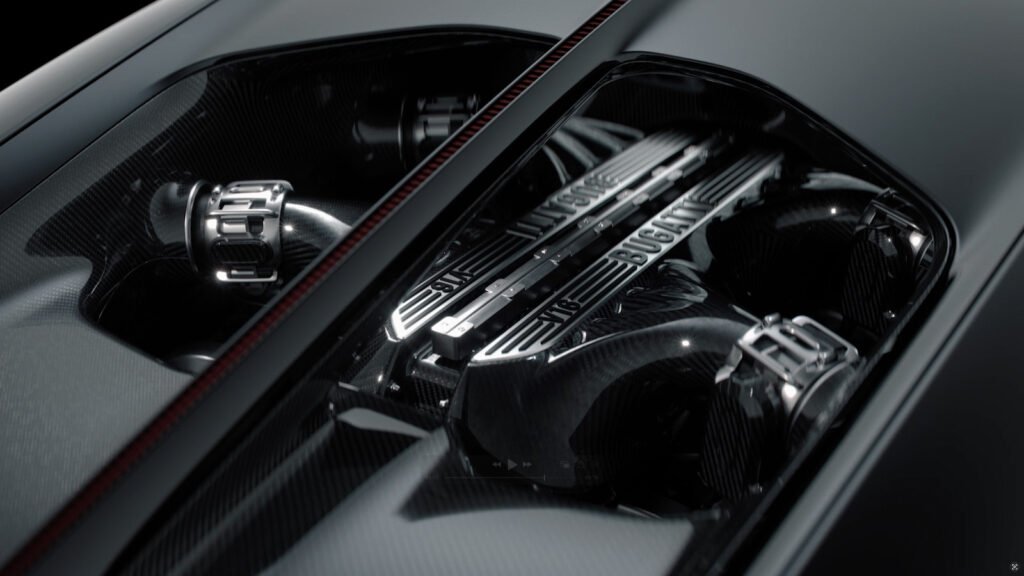
Bugatti Automobiles builds machines around engineering first. Its recent cars move from the quad-turbocharged W16 to the Tourbillon’s naturally aspirated 8.3-litre V16, paired with hybrid systems to produce 1,800 horsepower. The focus is clear. The engineering is pushed, then left visible.
Jacob & Co. works the same way in watchmaking. The movement is not hidden. It is opened up. Complications are placed in view. The mechanism is meant to be seen as it operates.
Most automotive-watch projects stay at the surface. This one does not.
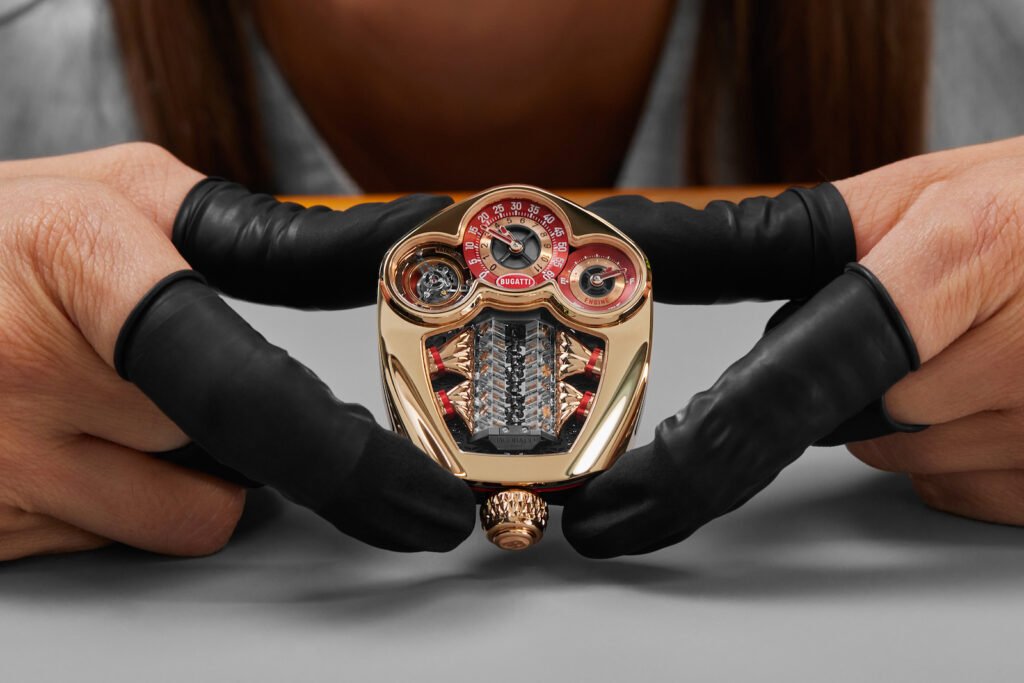
The partnership and the process
The partnership between Bugatti and Jacob & Co. began in 2019. It is built on a shared focus: mechanical performance, execution, and pushing beyond conventional limits.
That baseline sets it apart from the usual automotive-watch pairing. In many cases, the relationship is reduced to surface cues. Branding on the dial, colour taken from a livery, and minor details on a caseback or strap. The watch itself does not change.
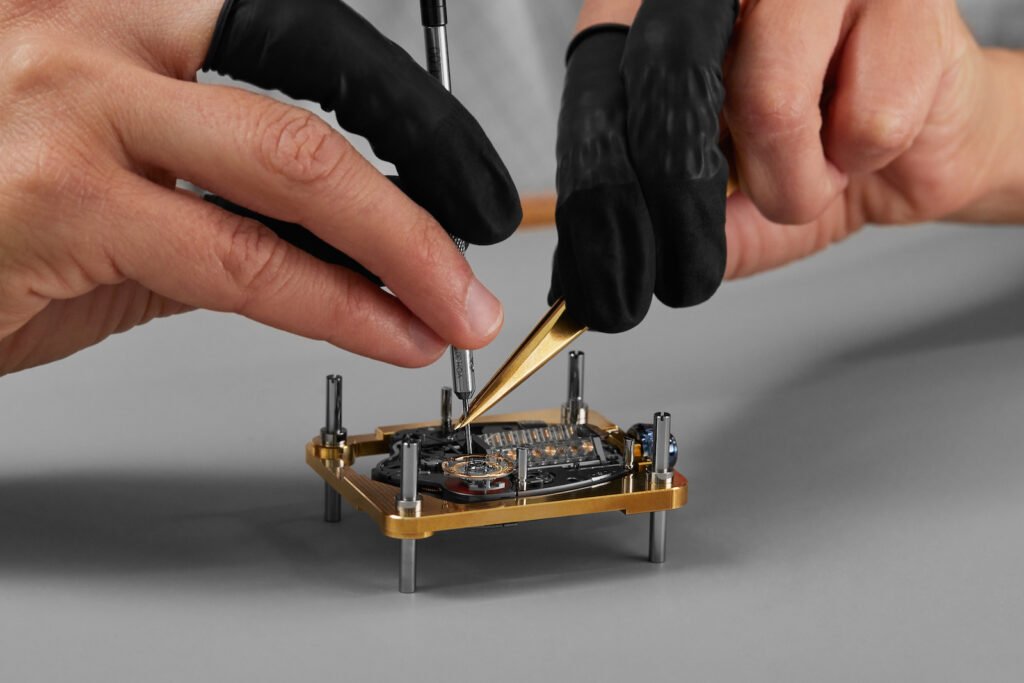
Here, the watch and car were developed together. They were part of the same program from the start. The timeline—under 18 months from development to delivery—reflects that. Both sides worked within a single design process, not in sequence.
The result shows up where it usually doesn’t. Not in styling, but in construction and display. Layout follows the same principles as the car. Mechanical references are direct. Information is presented in the same hierarchy as the instrument cluster.
“Hypertwin” is the term used to describe it. It holds. Two objects developed side by side. A shared system, expressed at different scales.
One system, two expressions
Two watches sit under the Tourbillon concept: the Bugatti Tourbillon and the Bugatti Tourbillon Baguette.
They share the same foundation. Movement, architecture, and mechanical layout are identical. The difference is how they are presented.
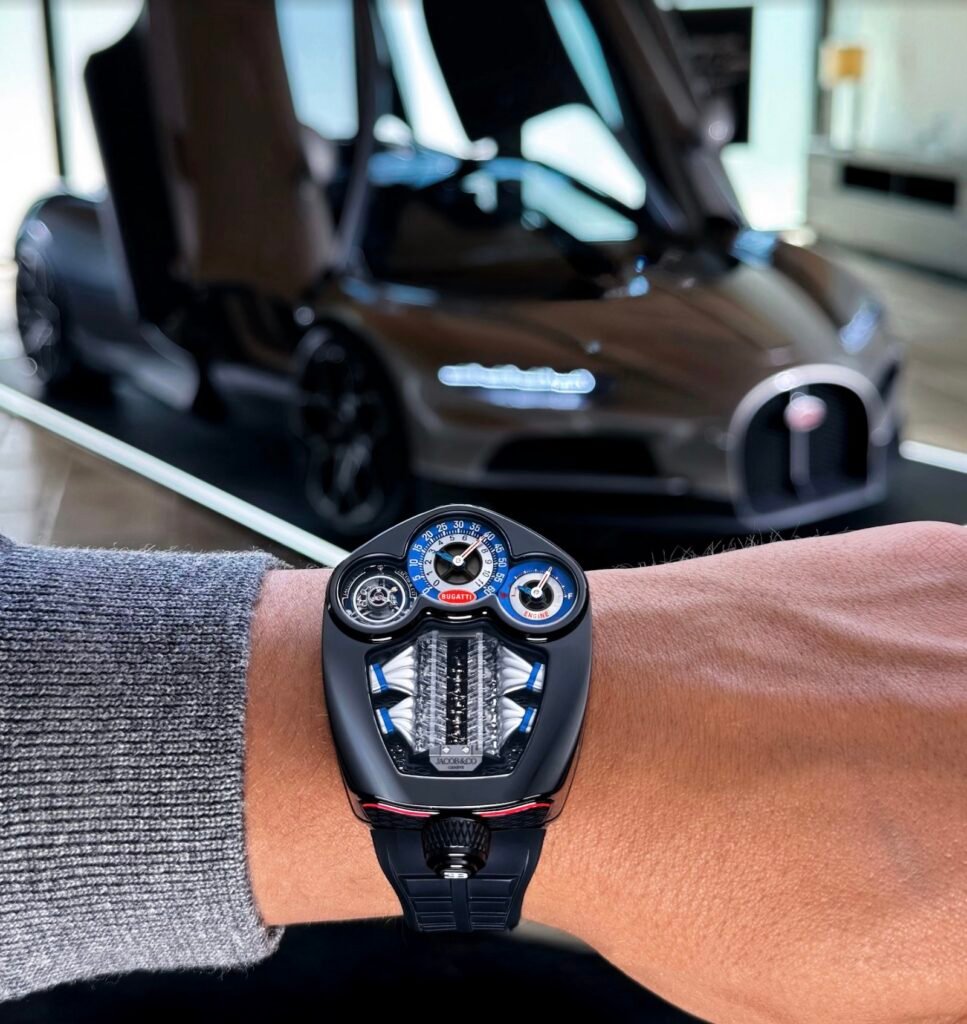
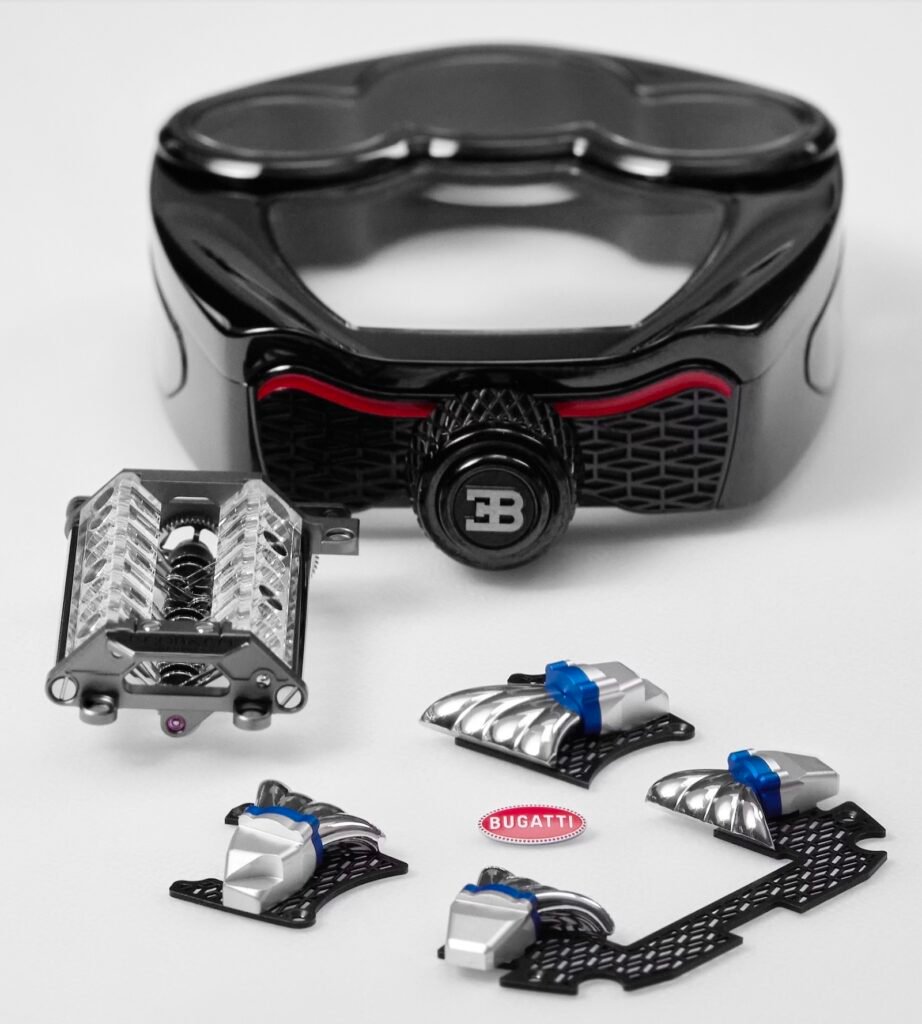
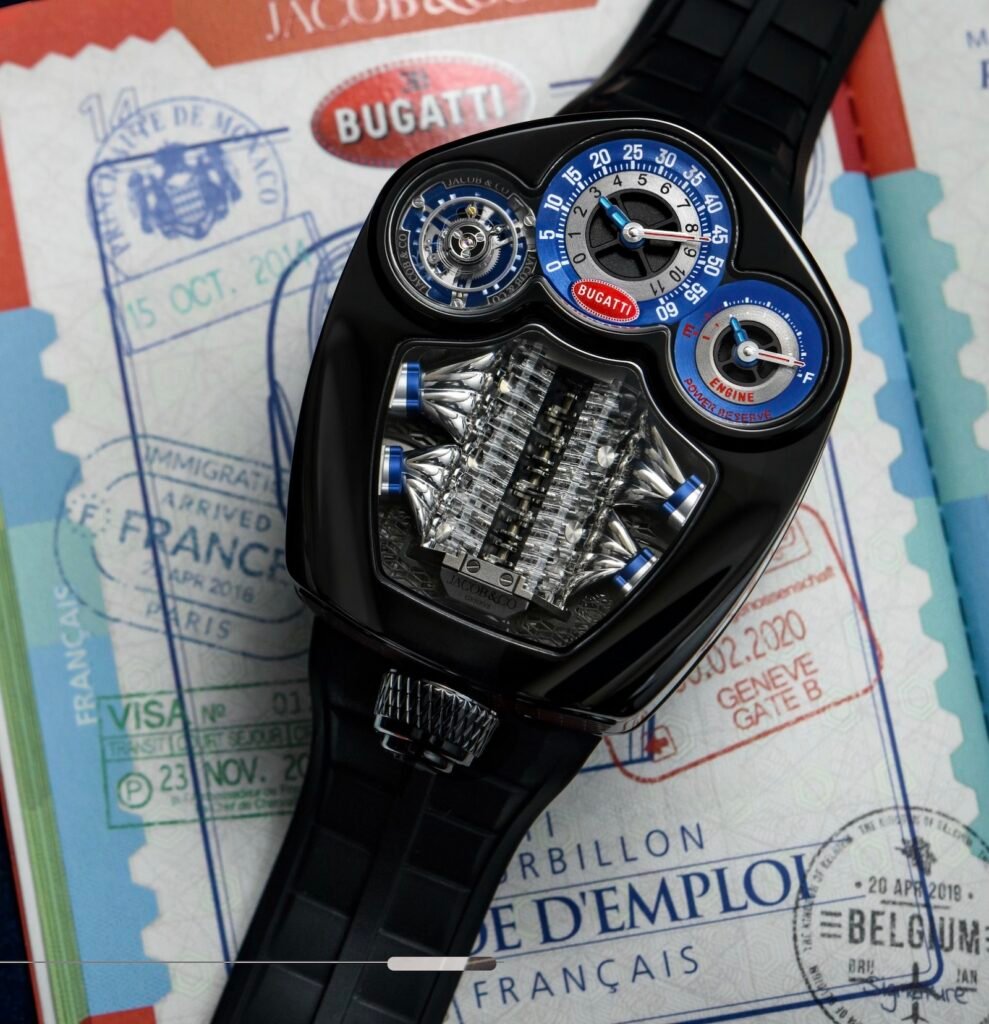
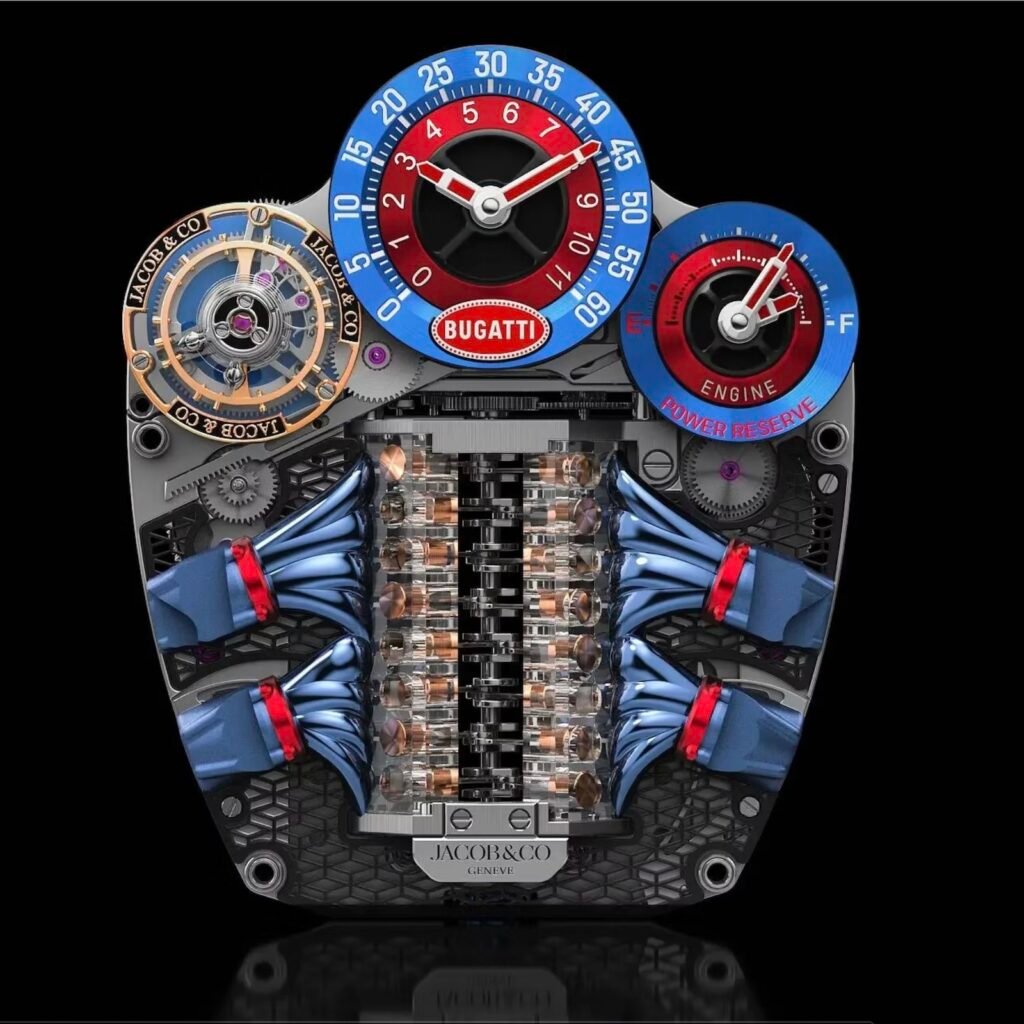
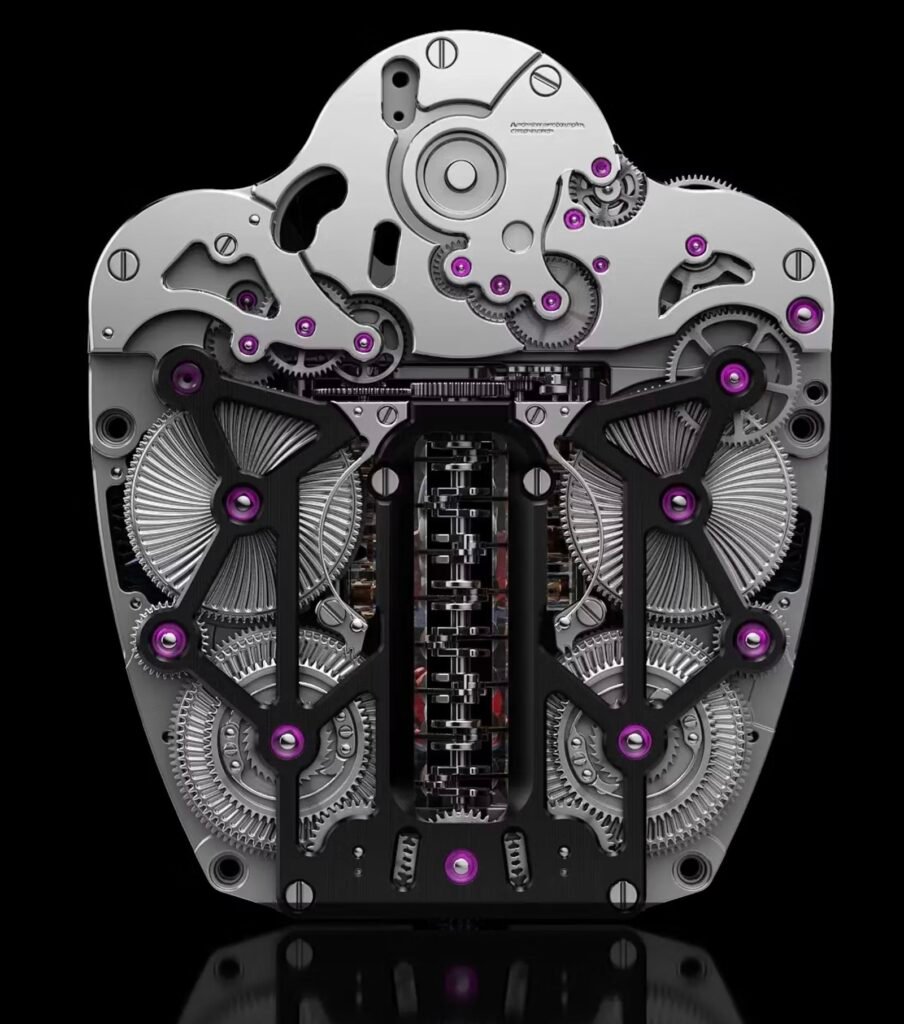
The standard Tourbillon is the direct expression of the engineering brief. Nothing is added. Nothing is redirected. The Baguette adds a second layer. It applies high jewelry to the same structure. The surface changes. The system does not.
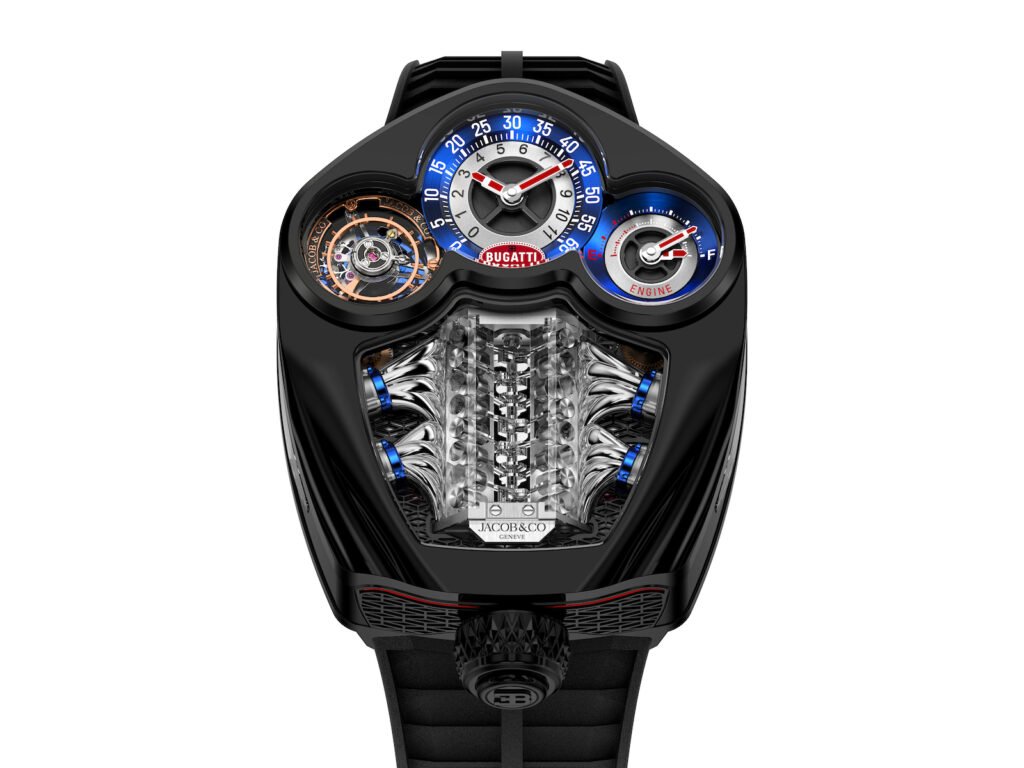
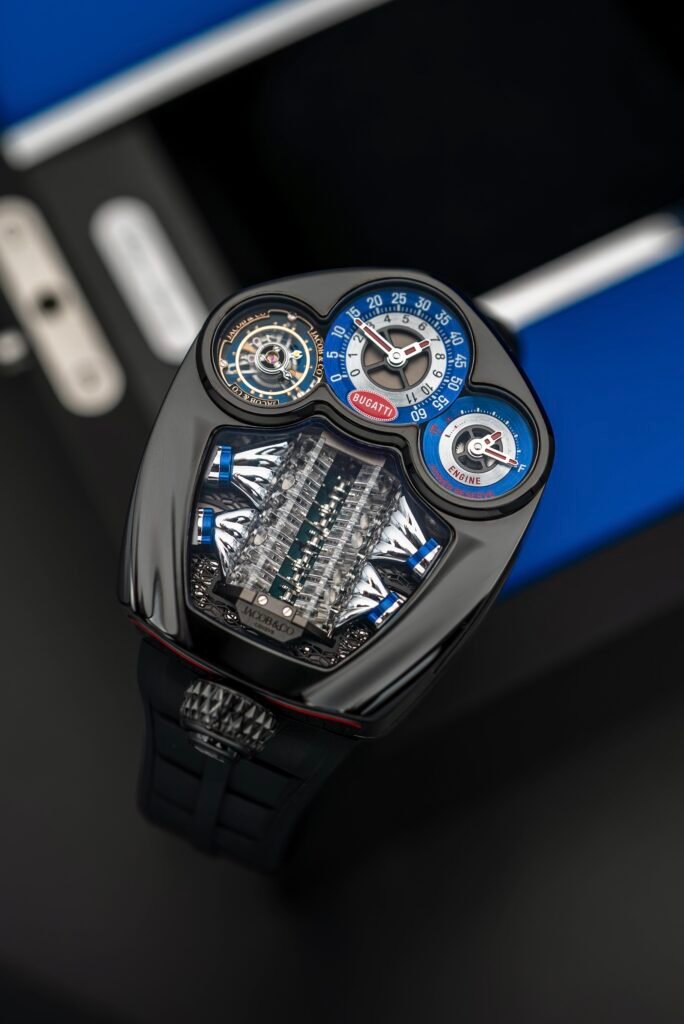
The integration works on three levels. Visually, the watch takes its design from the car. Mechanically, the movement and automaton behave like automotive systems. Functionally, the dial is laid out like an instrument panel. Information is separated and prioritized for immediate reading.
This keeps the focus on the standard piece. It reads most clearly as a mechanical object. It stands complete on its own terms.
The movement at the core
At its core is a hand-wound movement: the JCAM55 from Jacob & Co. It delivers an 80-hour power reserve. It runs at 21,600 vibrations per hour. It is made up of 557 components. These figures indicate scale and complexity. This is a large, complex calibre designed to be seen as much as it is to function.
Keeping it manual is consistent with the watch. Winding is part of the experience. There is no rotor. No automatic system running in the background. Energy is applied directly. The response is immediate and visible.
The regulating system is fully visible. A flying tourbillon completes a rotation every 30 seconds. That is twice the speed of the traditional one-minute standard first described by Abraham-Louis Breguet. The original purpose was technical. It reduced positional variation by rotating the escapement and balance. That function remains. Here, it also defines the visual center of the watch. It is exposed, always in motion, and central to the layout.
The faster rotation changes how it reads. It feels continuous rather than cyclical. The motion reads as constant activity, not a repeating cycle. It reinforces the watch’s focus on active, visible mechanics.
The dial as an instrument panel
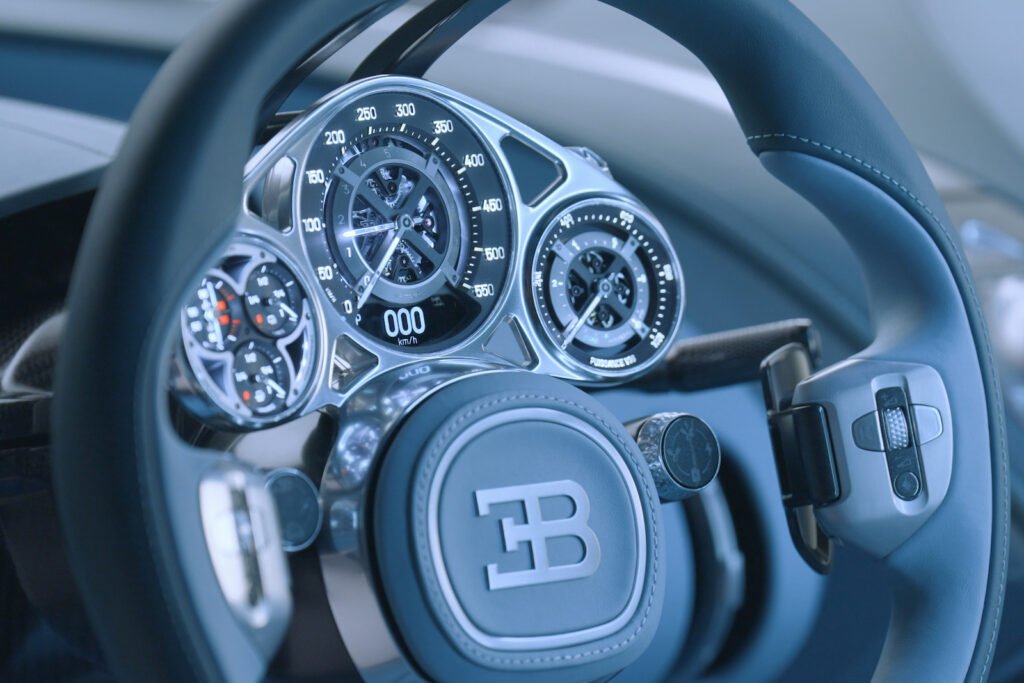
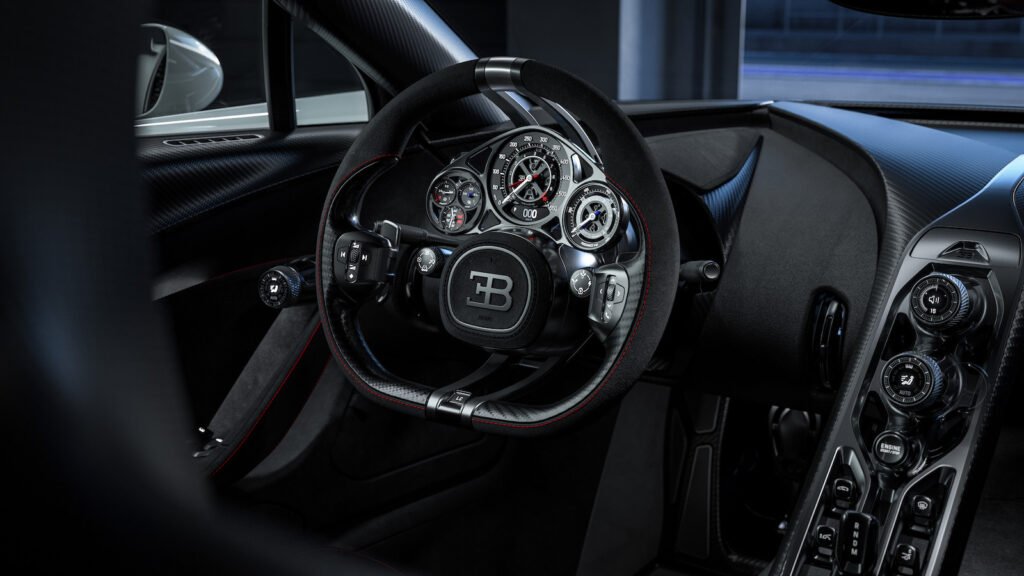
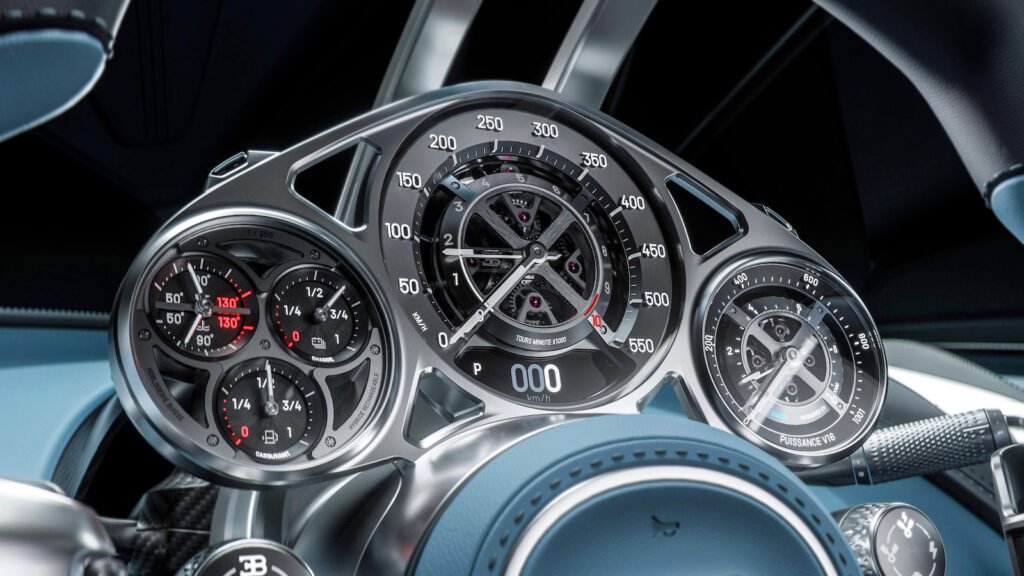
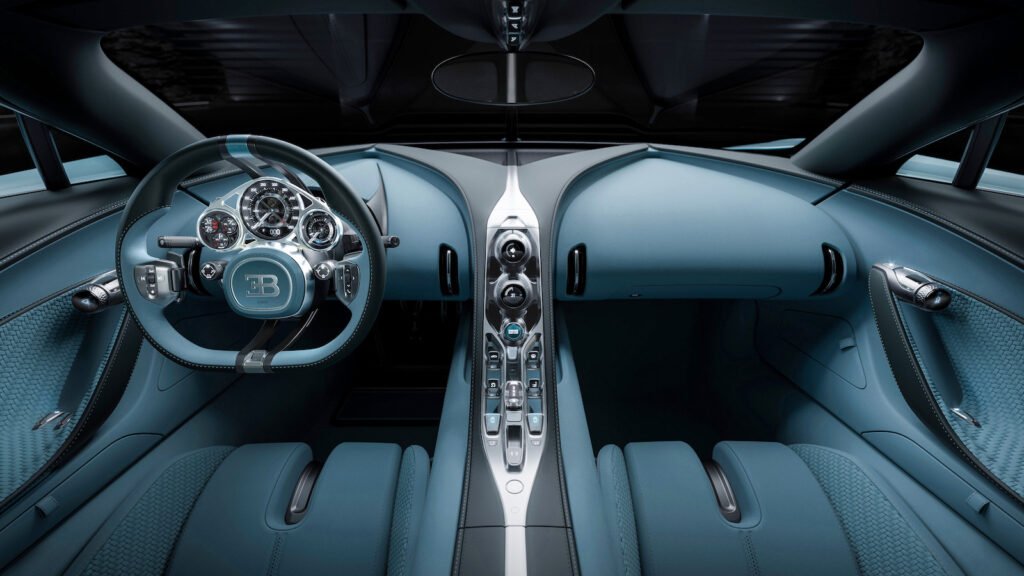
The reference point is the car. Bugatti’s Tourbillon replaces screens with a fully analogue instrument cluster. It was developed with Swiss watchmakers. It contains over 600 components. It uses materials such as titanium, sapphire, and ruby. It is finished to watchmaking tolerances. It is built as a permanent assembly, not a replaceable display.
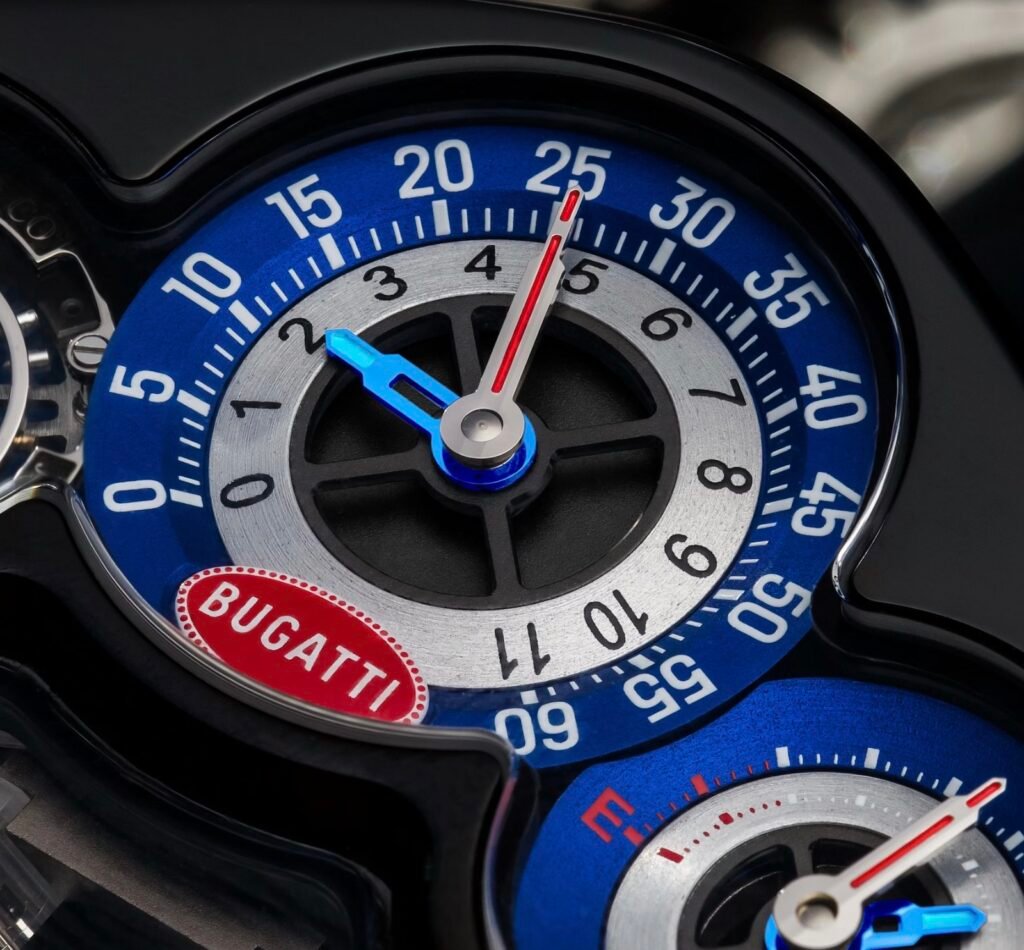
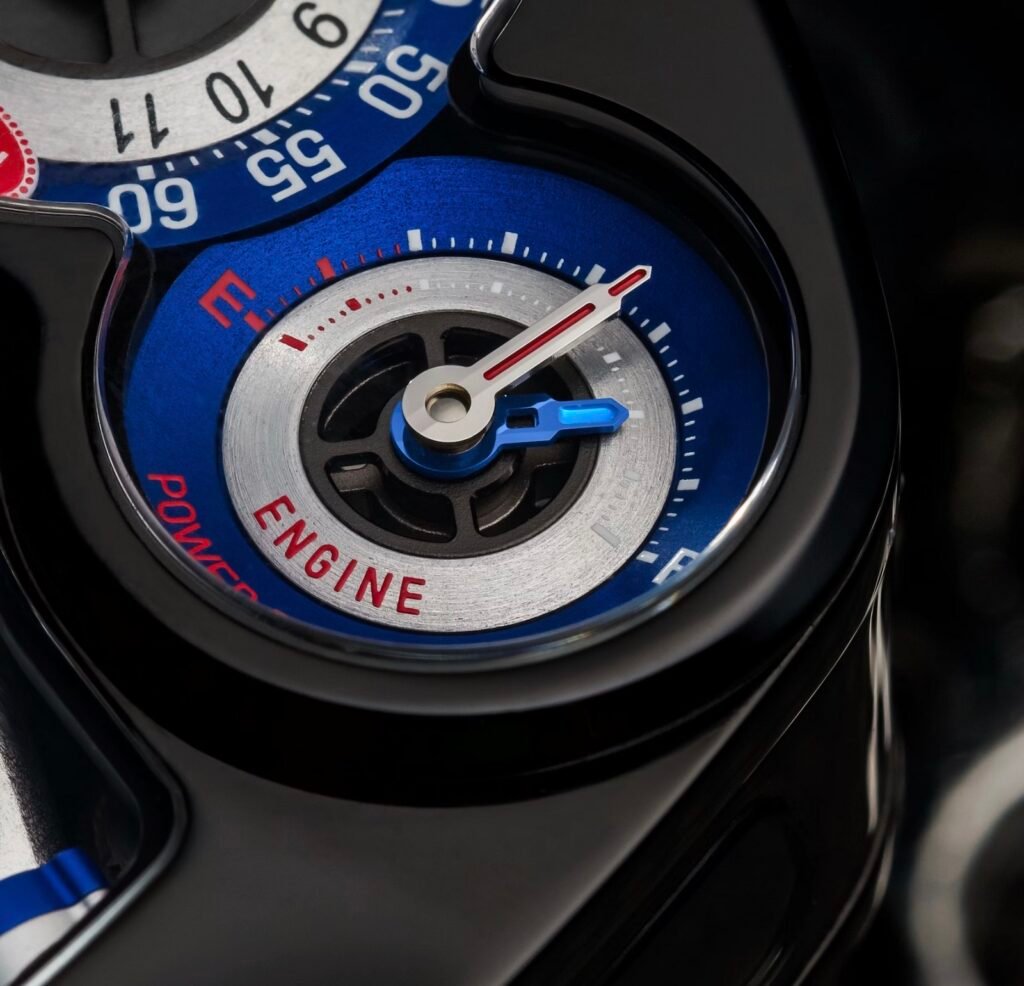
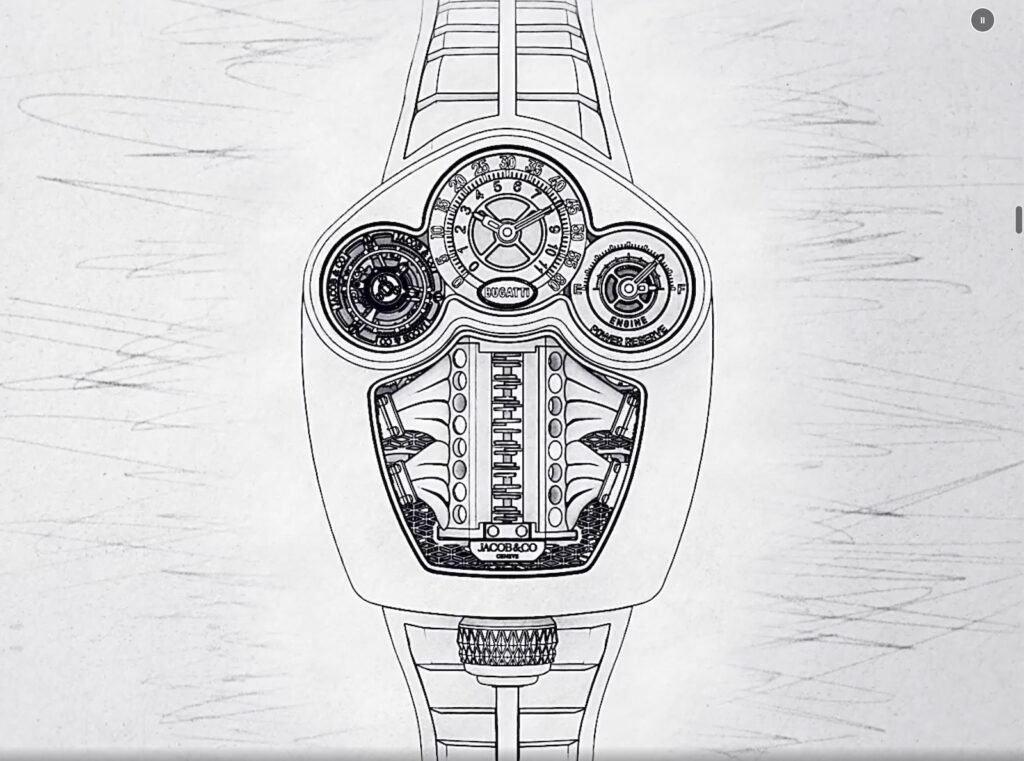
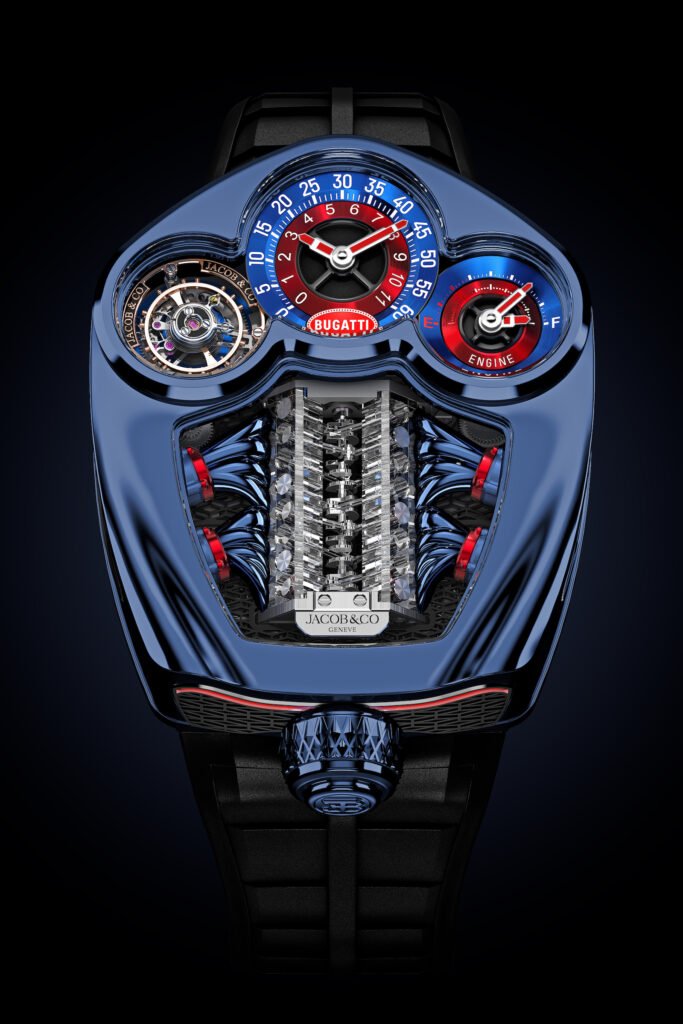
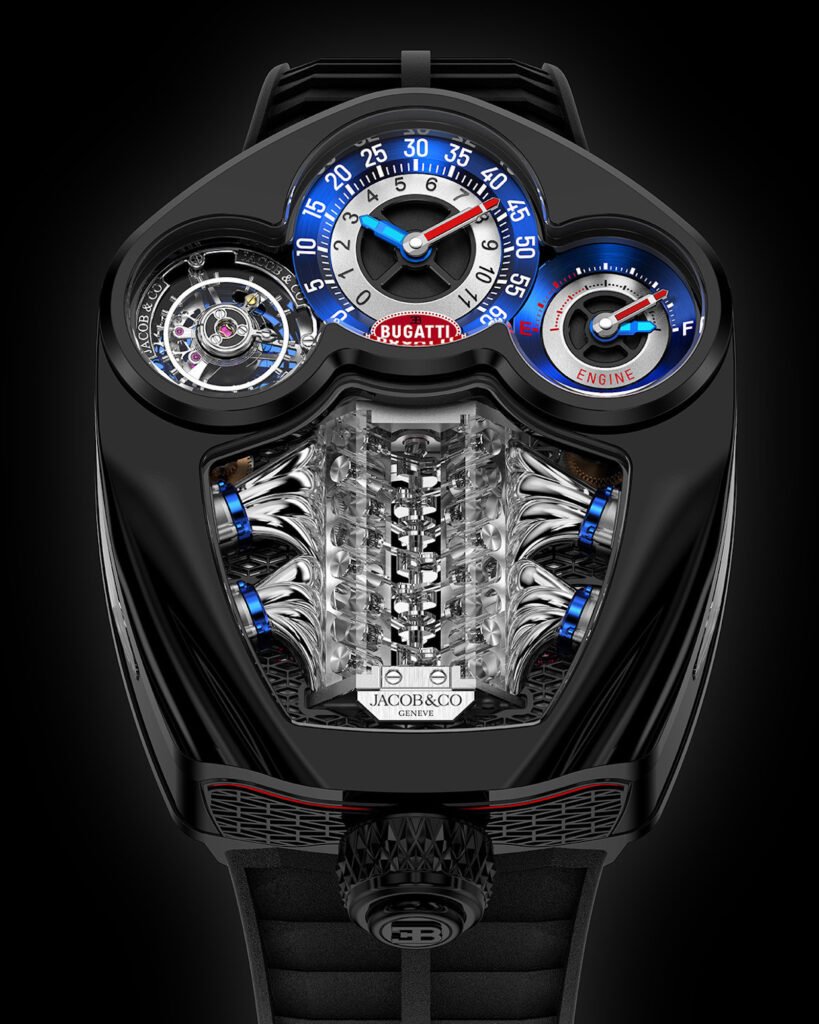
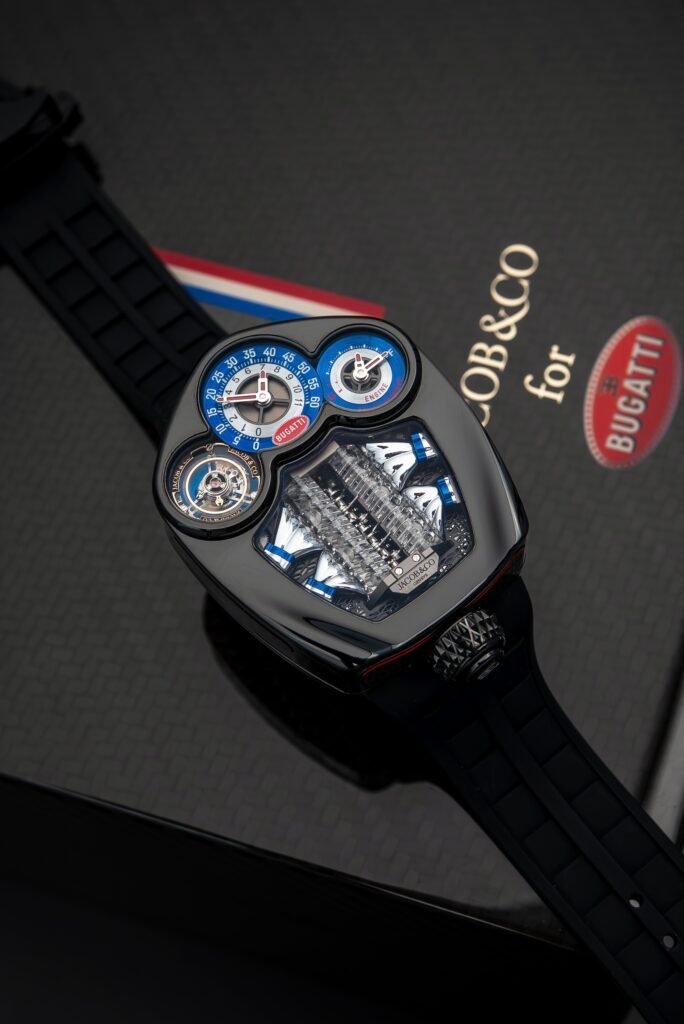
The watch follows the same approach. The dial is divided into distinct readouts. On the left, the 30-second flying tourbillon runs continuously. At the center, the time display sits off-axis. Its layout follows the structure of a tachometer or speedometer. On the right, the power reserve is split into two parts. One shows the 80-hour reserve for the movement. The other uses a secondary hand to track the automaton.
The details support that layout. Blue and silver define the main displays. Red hands provide contrast. The Bugatti signature is present but does not dominate.
This is not a dial with automotive styling. It is organized like an instrument panel. Each function is separated. Each is easy to read. Each is mechanically driven.
The idea extends beyond the watch. Most modern cars now use digital dashboards. Those systems are replaceable. Bugatti takes the opposite approach. It builds something permanent. The watch does the same. Information is delivered through moving components, not screens.


The engine in the watch
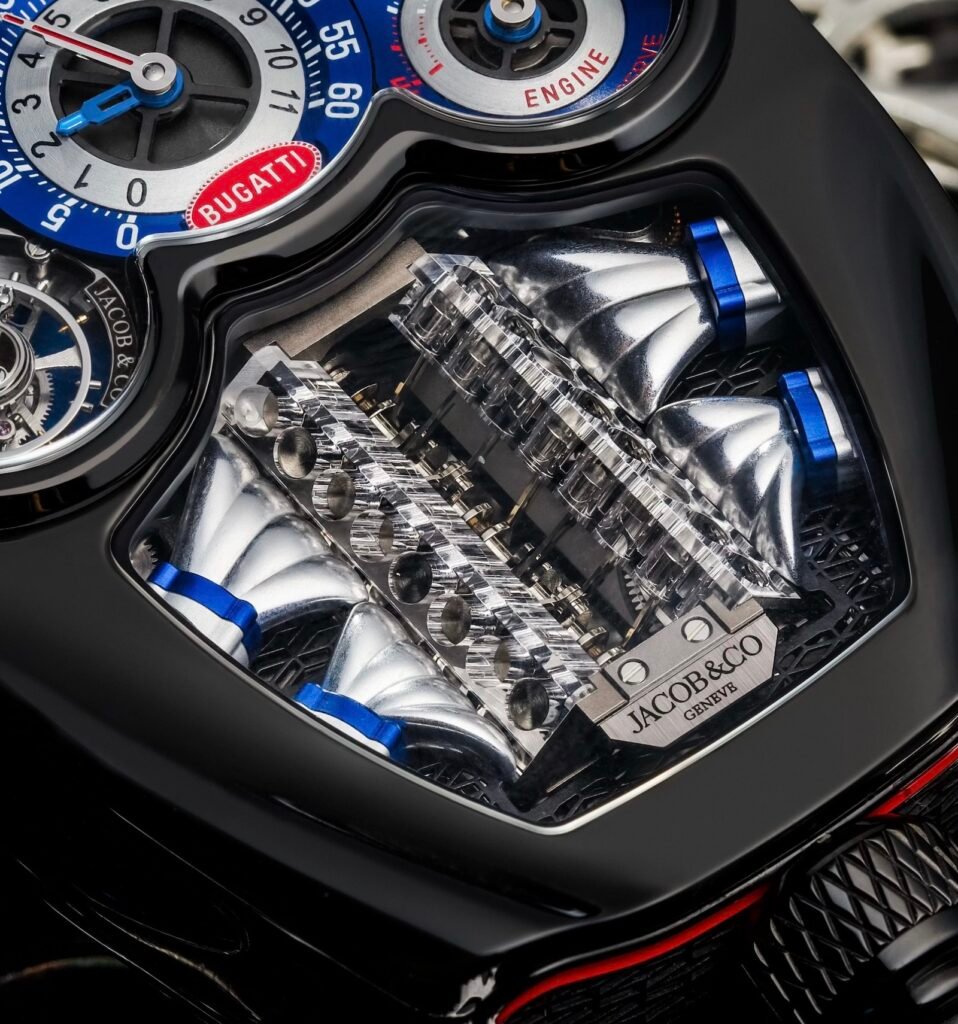
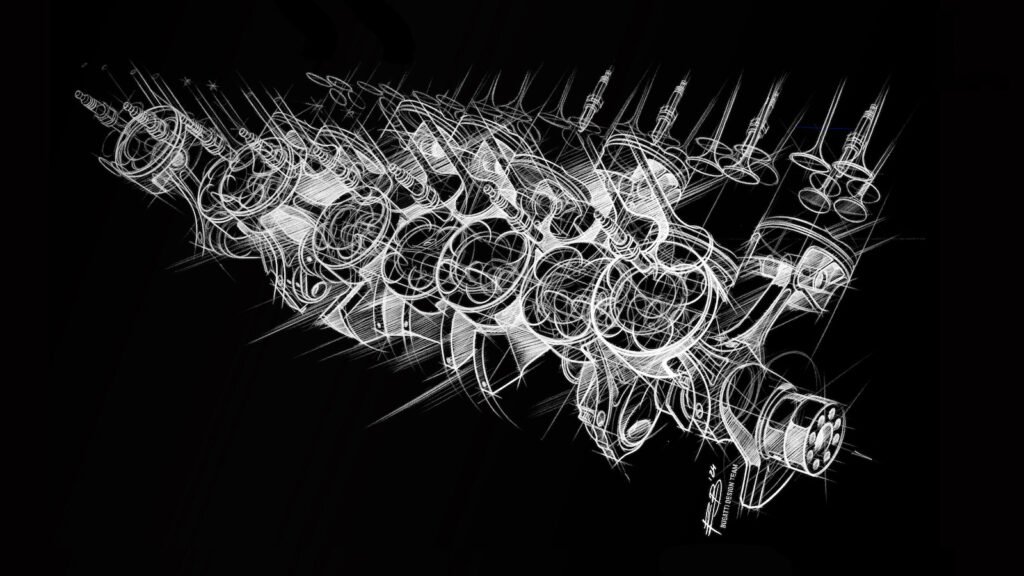
Beneath the dial sits the defining element: an engine-block automaton built around Bugatti’s V16. The block is made from transparent sapphire crystal. It exposes the entire assembly. Inside, 16 titanium pistons are aligned along a single-axis crankshaft. The crankshaft measures 22.37 mm. This is unusually long in watchmaking. It is central to how the system reads in motion.
Activation is immediate. A push of a button sets the crankshaft in rotation. It drives all 16 pistons through their cycle in sequence. The motion is coordinated. It runs continuously for the duration of its reserve. Every phase is visible.
The reference is direct. Bugatti’s current hypercar is built around an all-new naturally aspirated 8.3-litre V16. It was developed with Cosworth. It is paired with electric motors. The cylinder count and layout define the car. The watch reproduces that configuration as a working miniature system.
Automatons are not new to watchmaking. They are usually figurative or narrative. They show scenes or characters. Here, the subject is purely mechanical: pistons, crankshaft, and engine block. The movement shows function, not illustration.
It reads as a scaled mechanical cycle. An internal combustion process reduced to its essentials. The logic remains intact.
The case as bodywork
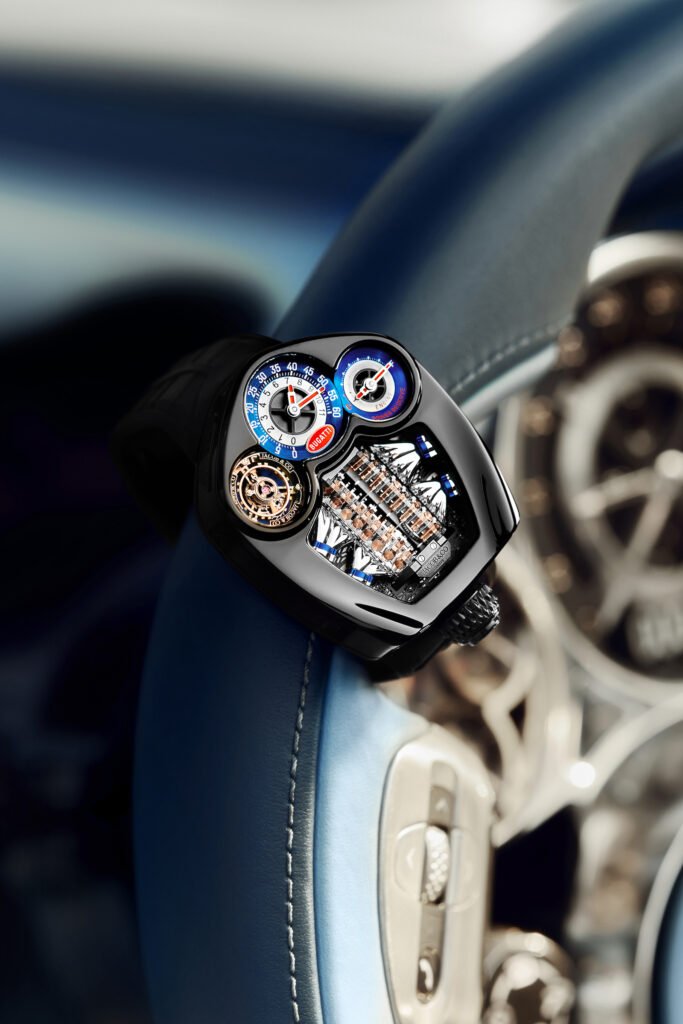
The case carries the same approach outward. It measures 52 by 44 millimetres. It is 15 millimetres thick. It is made from black DLC-coated titanium. It is capped with sapphire crystal. The scale sets the tone. The form does more than hold the movement.
The geometry comes directly from the car. The upper profile recalls the rear wing. The sides read like glazing. Sapphire inserts are shaped and tinted to echo side windows. They open views into the movement. Along the flanks, recessed sections mirror radiator architecture. They are finished with laser-etched grid patterns that reference cooling elements. Toward the front, the form tightens into grille-like structures. The mass compresses in the same way airflow is managed across an intake.
These are not added details. Bodywork, cooling, and transparency are built into the case. They are translated into watchmaking materials.
The same discipline applies. Surfaces are shaped by airflow, heat, and structure. The watch follows that logic. Grille, radiator, and window elements are integrated into the form. The result reads as engineered structure rather than applied design.
The wrist presence
The supporting elements are straightforward. The watch uses a black rubber strap. It is paired with a black DLC titanium deployment buckle. Water resistance is rated to 30 metres.
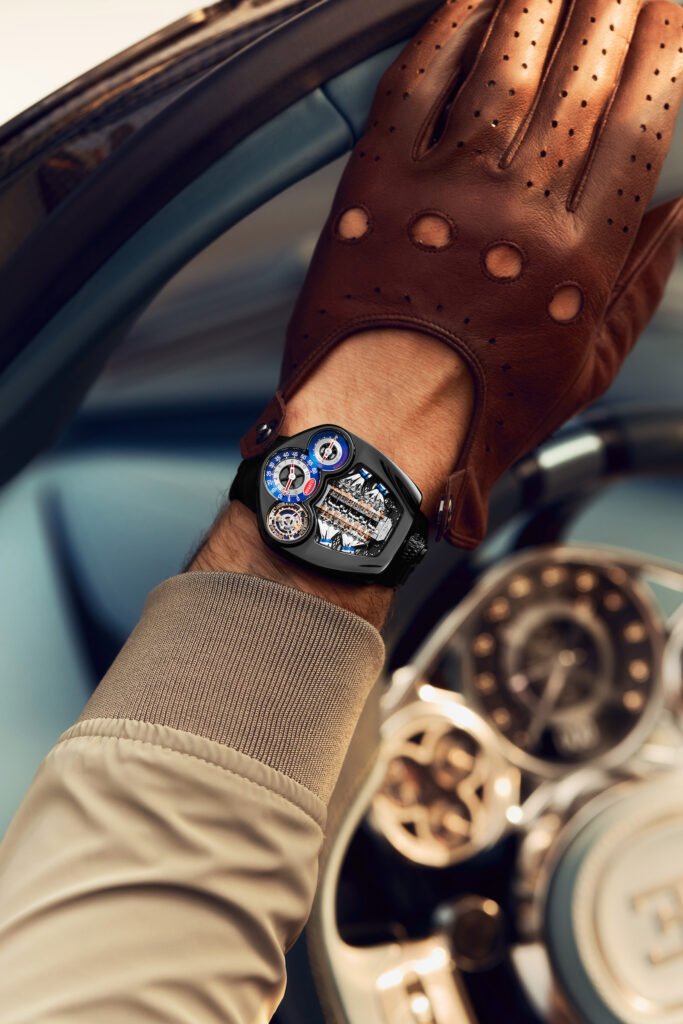
It does not recede. The scale is large. The geometry is pronounced. The mechanics are exposed. Together, they push in the opposite direction. On the wrist, it reads as a constructed object. It is defined. It is overtly mechanical.
That changes how it is worn. This is not a sports watch designed to go unnoticed. It presents itself immediately. It feels closer to a compact machine than a discreet instrument. The decision extends beyond timekeeping. It is about wearing a visible mechanical system in operation.
The production limit
Production follows the same constraints as the car. The standard Bugatti Tourbillon is limited to 150 pieces.
That number is not arbitrary. It reflects the complexity of the watch. It reflects the time required to build it. It reflects the level of precision involved. Production stays low. Each piece requires significant effort to complete.
This matches Bugatti’s approach at the top end. Volume is not the goal. The limit is set by what can be engineered and built to a specific standard. The watch follows the same model. It emphasizes rarity and mechanical depth.
The baguette variant
A second version sits alongside it. It uses the same architecture. It is expressed differently. The Bugatti Tourbillon Baguette is limited to 18 pieces.
The case is made from 18K white gold. It is set with 17 carats of baguette-cut diamonds. In total, 328 diamonds are integrated into the case. There are also 18 baguette-cut rubies. They are arranged to reference the car’s taillight signature. The setting is invisible. There are no visible prongs. The surface appears continuous.
Nothing changes beneath. The movement remains the same. The automaton remains the same. The layout remains the same. Only the exterior expression shifts. Material intensity replaces exposed surfaces.
That contrast defines the platform. In standard form, the Tourbillon reads as an engineering-led object. It is shaped by mechanical layout and visibility. In Baguette form, the same system is reframed through high jewelry. The mechanics do not change.
The mechanical thesis
It holds together by avoiding shortcuts. There is no reliance on branding cues. The car is not reduced to surface detail. The translation goes deeper.


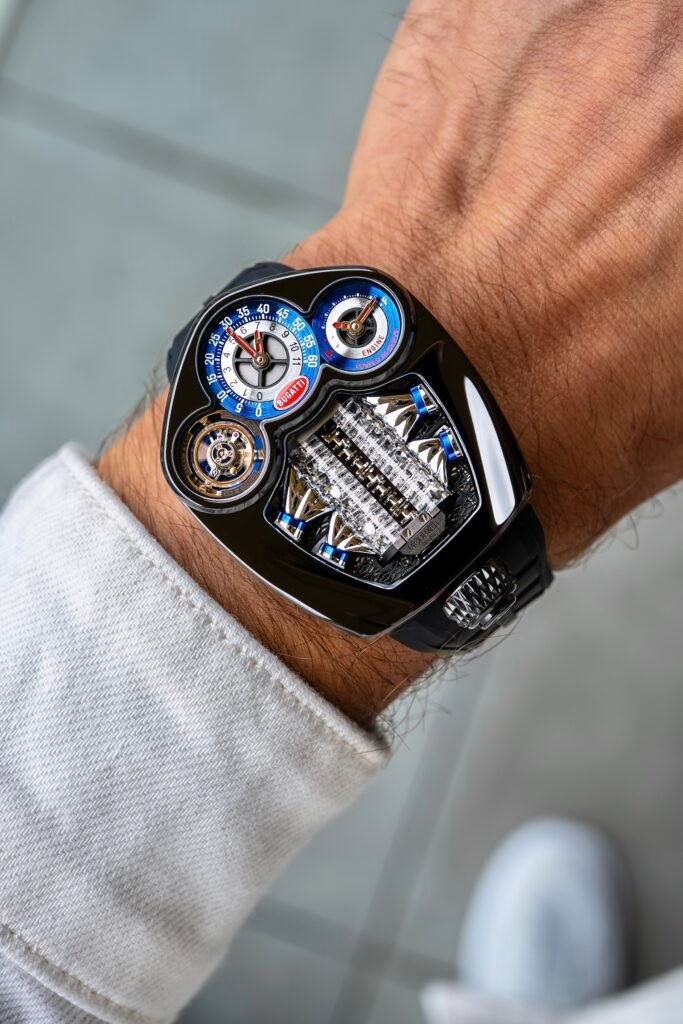
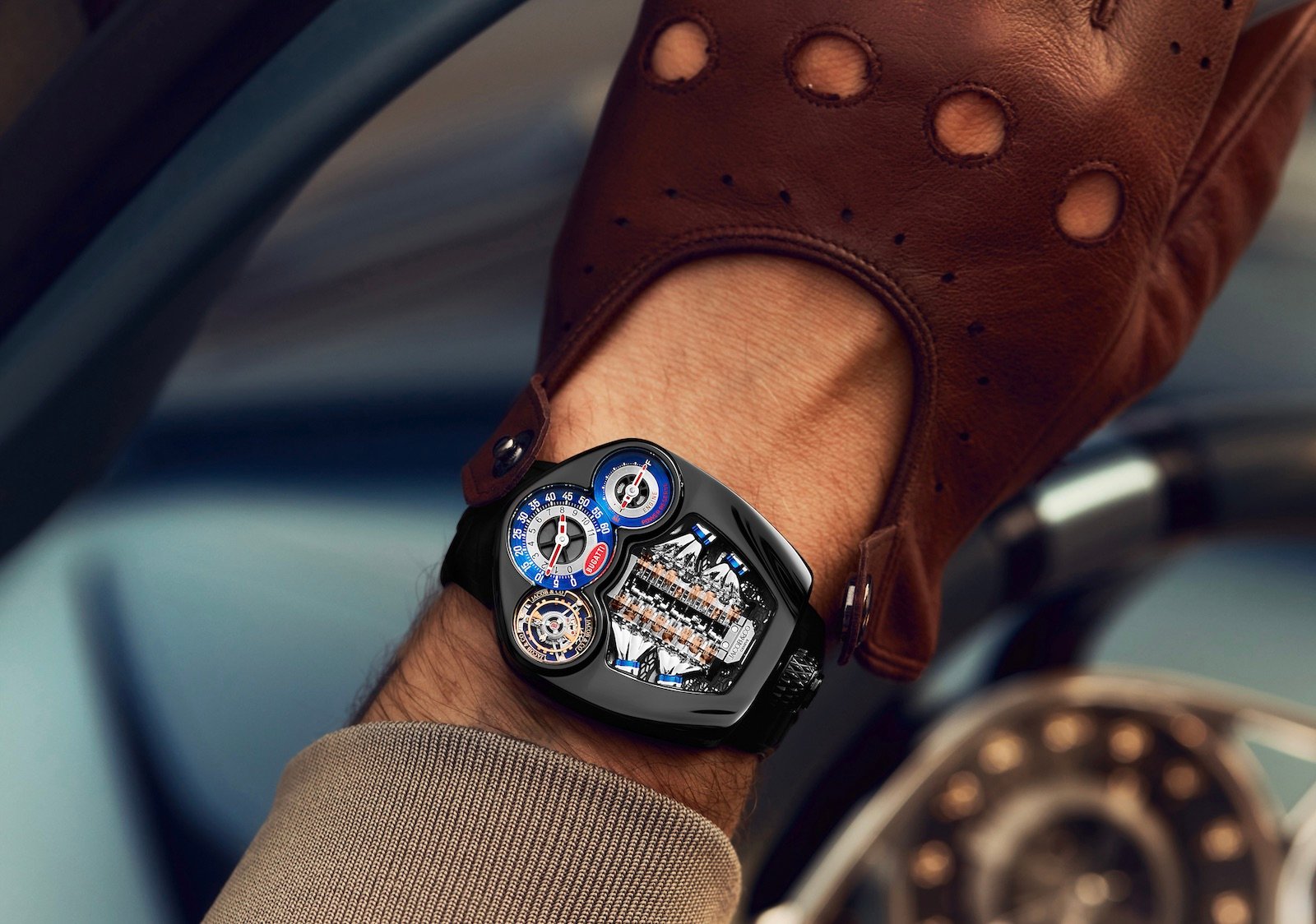
The same principles carry through both objects. Analogue instrumentation is treated as permanent. Mechanical systems are kept in view. The architecture is built around a V16. These elements define the car. They reappear here at a different scale with the same intent.
The watch is built around a hand-wound movement. It includes a flying tourbillon. It includes a fully developed automaton. This gives it credibility as high watchmaking. At the same time, it remains easy to read through an automotive lens.
This is where it separates. Not a crossover. Not a licensing exercise. Two objects engineered from the same foundation, resolved in different forms.