
Photography by Elle Alder.
Heave an old independently sprung 4×4 off its feet and you’ll typically notice a certain knock to its knees.
Heels droop in toward one another, toes drift, it all falls a tad Lightning McQueen. Such misaligned kachows might not matter a whole lot on the cottage-trail plod, of course; a mud tire usually just needs to find something soft to tug at, regardless of angle or axis. But what about at speed?
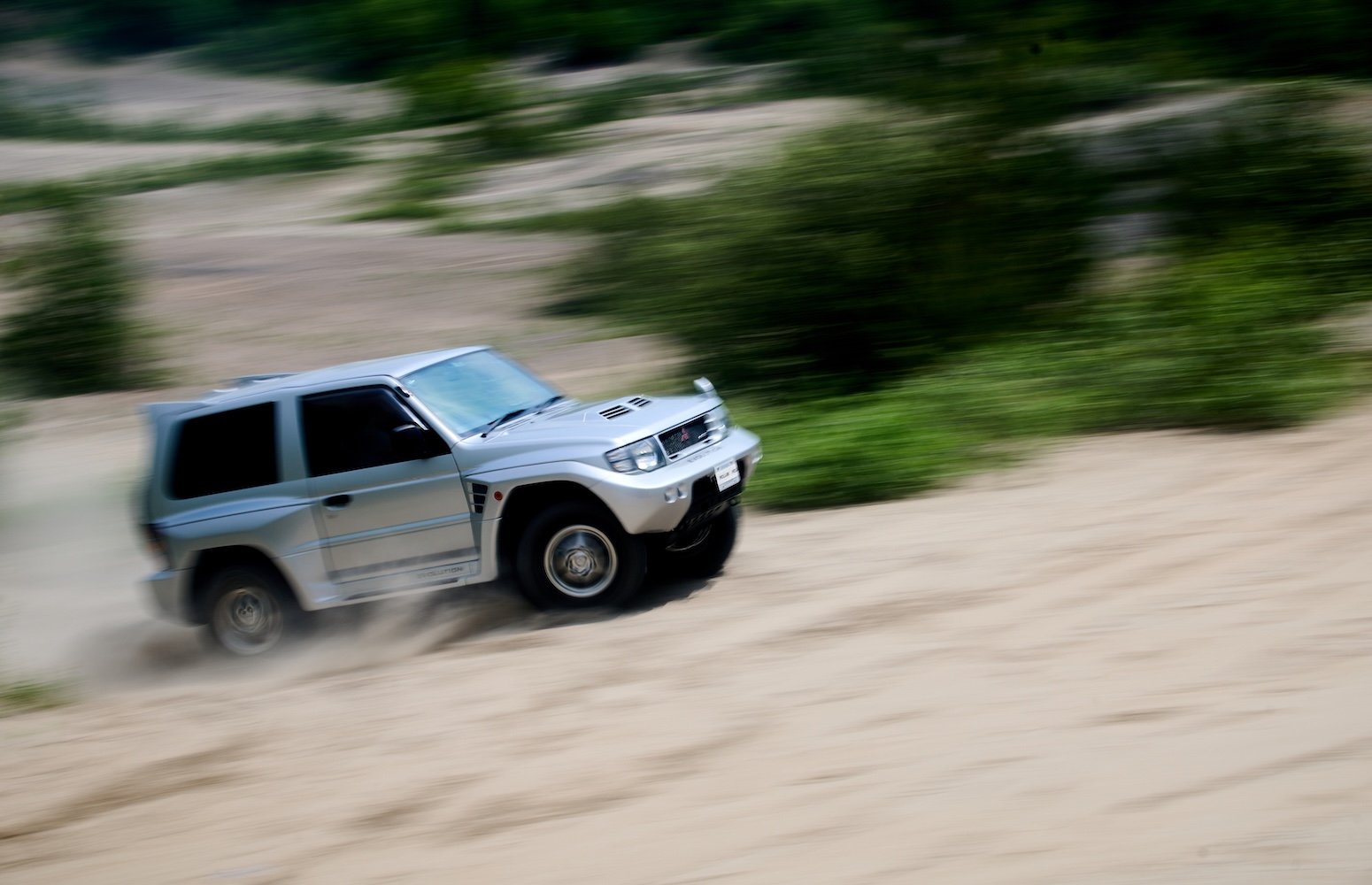
Sail over a sand dune at 160 km/h, and that same footing could mark your colourful end.
If you’re lucky, those toes will point inward and slice back into the sand like a ship’s bow through water, hopefully guiding you straight by the skin of your teeth; if you’re not, they’ll part in the air and try to scoop the car violently to one side on landing. Add a nervous inward stance and multiply it the longer travel of an off-road suspension, and now they’re trying to land a 4,000-plus-pound deadlift in Stilettos. Off balance, feet together, about to roll an ankle — you’d better brace for the bruises, because you’re going over.
Such game-ending tumbles were a matter of course for early off-road utes competing in the notoriously unforgiving Dakar rally, but not all challengers acquiesced to the danger. Chasing the prestige of that 10,000-km trophy, manufacturer teams outgrew their mass-produced models and built ‘Prototype’ racers that only superficially resembled them. Beneath the skin could hide systems and technologies well beyond what anybody might hope to see on the road, and the race’s organizers took notice.
So it came that for 1997, major manufacturers were ordered to leave their abstract playthings behind and turn up to the start with real cars. Excepting some adaptations for safety, supplies, and serviceability, a new ‘Modified Production’ class would be populated by vehicles that actual consumers — minimum 1,000 each year — could buy.
For then-powerful Mitsubishi, this presented a threat. The brand had built a reputation for endurance-rally success through the past two decades, one which had come to anchor the brand’s marketing and identity as rally and endurance champions. But while it sold some respected low-cost off-road models, its showrooms hadn’t anything within a cage, seat, and fuel tank of continued Dakar glory.
Brought to life in answer: the Mitsubishi Pajero Evolution.
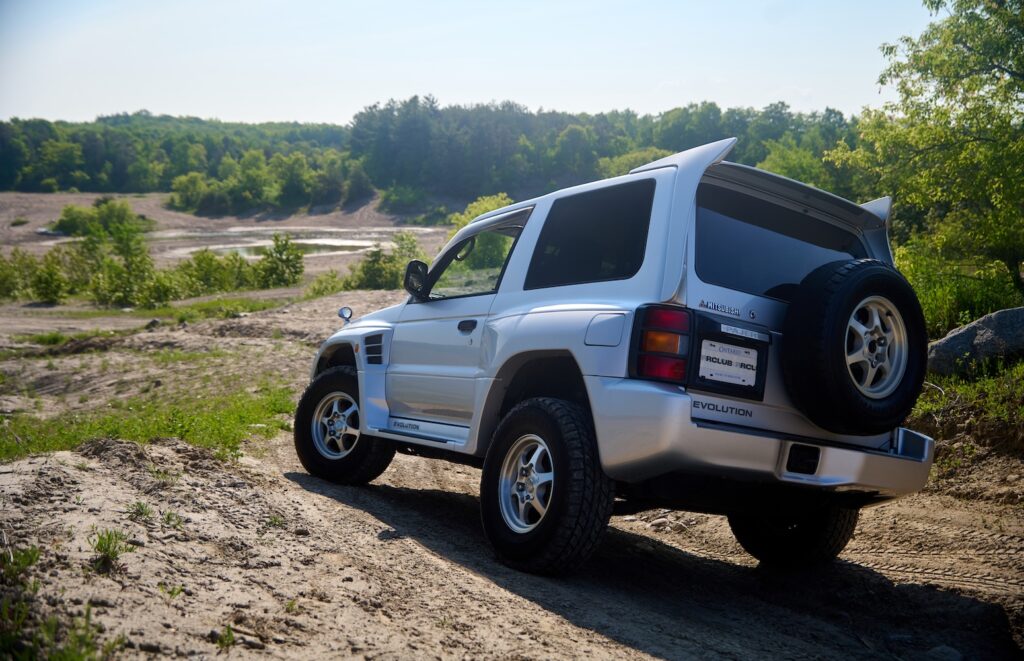
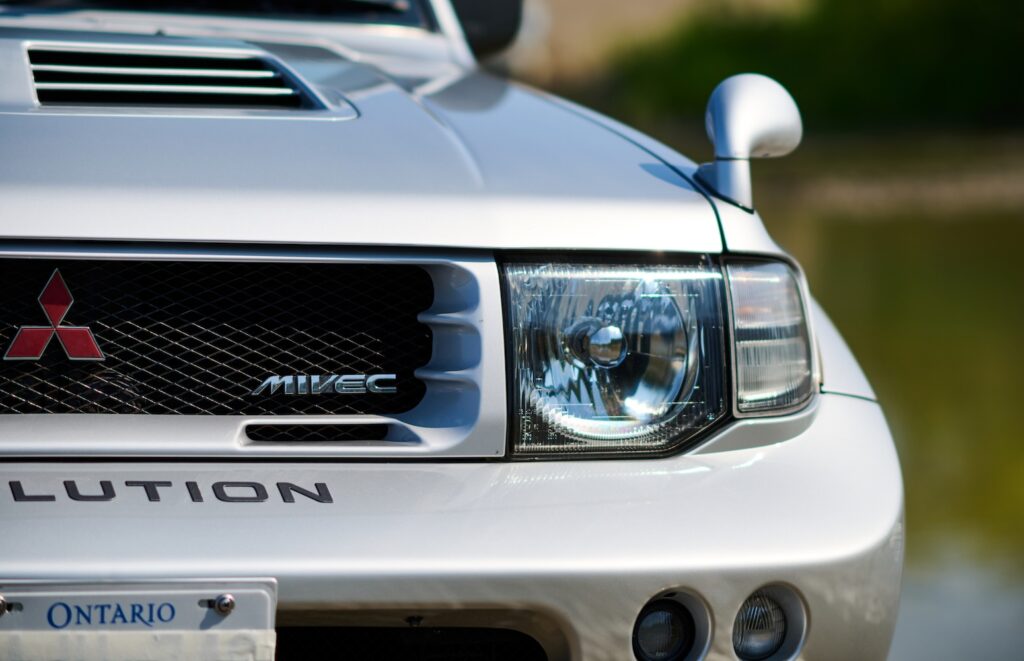
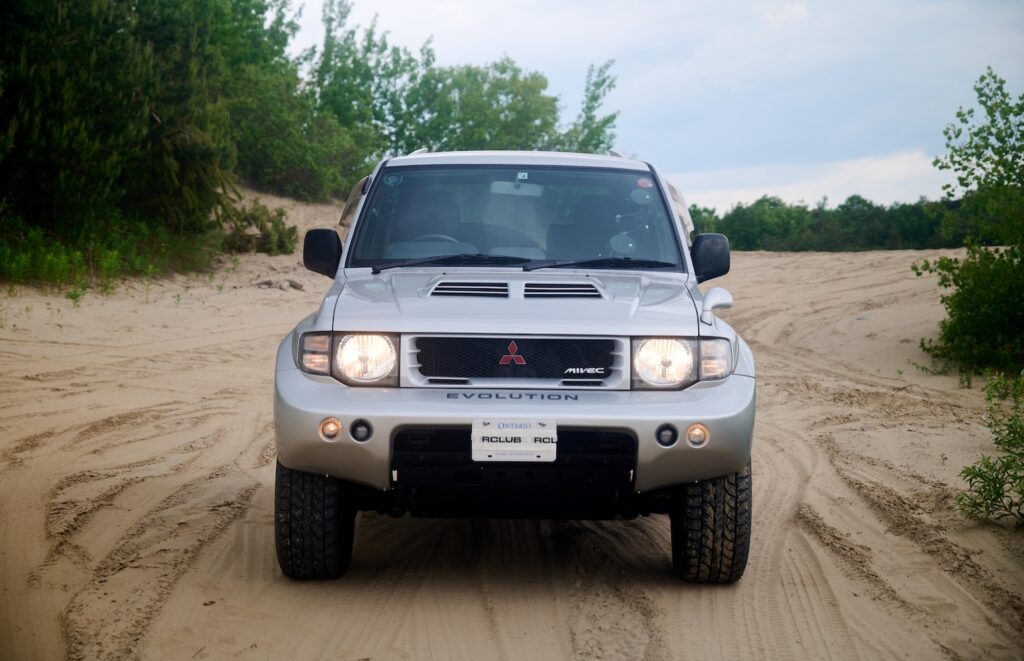
Built from 1997 through 1999, this last great motorsport homologation special assumed the basic platform of the three-door Pajero (‘Montero’ in markets where that name inconveniently translated to ‘wanker’), then ruggedized, uprated, and reconfigured its traditional pedestrian outfit into a most serious contender. Only limited and basic modifications were to be allowed, so while the Evo was still a road car built to the era’s standards, all core systems and architectures templated those that Mitsubishi intended to race — zany body kit and all.
Under a lightweight aluminum hood, an evolved 3.5-litre V6 brought the Pajero into the modern age with the integration of variable valve timing for more full-pedal push at high revs. Race requirements for the class dictated natural aspiration, so there would be no turbos to help. By switching to a second set of cams and valves past roughly 5,000 rpm, however, the Evolution could inhale some 30 percent more for more vigorous combustion. Making even more of this, a dual-plenum variable intake enabled the engine to accelerate the air on its way into the cylinders, energizing that air-fuel mix for optimal explosions.
On paper, power was rated per the Japanese manufacturers’ ‘Gentleman’s Agreement’ at 276 horsepower; later dyno tests have suggested something around 300. Torque was advertised at 256 pound-feet; plenty for an advantageous 4.3:1 final drive ratio. This was good to accelerate the Pajero Evolution’s 4,343 pounds to 100 km/h in 6.9 seconds, then on to a top speed of 210 km/h.
Remember though: desert. Such power and speed across such unpredictable terrain called for suspension entirely unlike the heavy solid axles Mitsubishi had been sticking under its standard second-gen Pajeros.
To keep the new rig’s poise, the Evo’s engineers simply took what they’d been doing in their successful-until-spurned prototype-class racers.
Branded ‘ARMIE’ for ‘All-Road Multilink Independent Suspension for Evo’ this arrangement mounted racecar-style double wishbones at the front. Stretching a full 24 centimetres up and down on easily swapped MacPherson struts, these twin arms enabled the Pajero’s reinforced spindles to move perpendicularly to the frame without drooping those heels inward when unloaded. Rear wheels got a breakover-friendly multilink setup, each with a primary control arm triangulated by a thick trailing arm down below, then a series of arms aligning all of the rest.
Though new-generation ‘soft-roaders’ for the Walmart-running McMansion-lifestyle generation had started to work with independent fronts, most properly purposeful off-roaders were still holding to their tried-and-true solid axles.
As a result, the ‘Pajevo’ drives rather unlike most of its contemporaries. Though it still feels ‘90s to the core, the handling dynamics of this race-targeted suspension make the Pajero Evolution respond with unexpected modernity.
On the road and highway, the Pajero Evolution arguably feels steadier than a modern Jeep. Straight in its lanes and stable across its extra six inches’ width, the Evo is an unwavering breeze to live with. In the city as well, high seating and the open-glassed greenhouse afford such great visibility that its right-hand driving position feels no particular detriment in left-drive traffic. What’s more, the agile short-wheelbase chassis and clearance-cropped overhangs make it a breeze to parallel park.
To bind it to the tarmac would be a waste though: run it out to that 7,000-rpm redline on a trail and the platform stuns. The Evo invites you to find speed in the dirt, appropriately noisy but otherwise unperturbed by undulations that would pucker most peers. Complemented by the bump-eating sidewalls of 31-inch tires mounted to purposeful 16” aluminum wheels, the Pajevo’s suspension
More than just bump- and jump-ready poise or the shock-eating sidewalls of 31-inch tires, independent suspension and lighter aluminum wheels mean less uncontrolled mass.
Much like the alignment when airborne, this is hugely important: whereas a car insulates itself from bumps using its springs and dampers, the wheels and the ‘unsprung mass’ immediately attached to them bounce beneath without such a luxury. More mass would more inertia to each bounce, that the suspension will have to work harder to bring it back under control, and that you’re more likely to feel it up top — either as an uncomfortable shock, or as an entirely destabilizing buck to the chassis’ footing. This is why a Jeep’s heavy beam axles, though great for slow crawling, make for a skippy and even uncontrolled-feeling ride over bumps or around off-ramp expansion joints at highway speeds.
Even with their strong steel reinforcement, those independent corners and lighter aluminum wheels mean less unsprung mass dancing beneath the car, less strain on their mounts, and less danger of destabilization at speed. By this, the Pajero Evolution is poised both on the trail and at speed across dunes, affording a ride enjoyable and impressive even without subjecting the ute to the mechanical cruelty of any landings.
Suspension is only one consideration to going airborne, however: the powertrain also needs to survive. Without traction keeping the wheels and engine matched to their speed over the Earth they’ve left behind, the entire driveline falls out of sync.
Whatever speed the wheels, transmission, and engine might’ve been coasting at as they kachowed through the sky, they will suddenly be forced up or down to that speed. To make matters even less forgiving, the landing will weigh enormous force — several times the truck’s usual weight — down onto the tire treads, forcing more aggressive traction than perhaps any other moment.
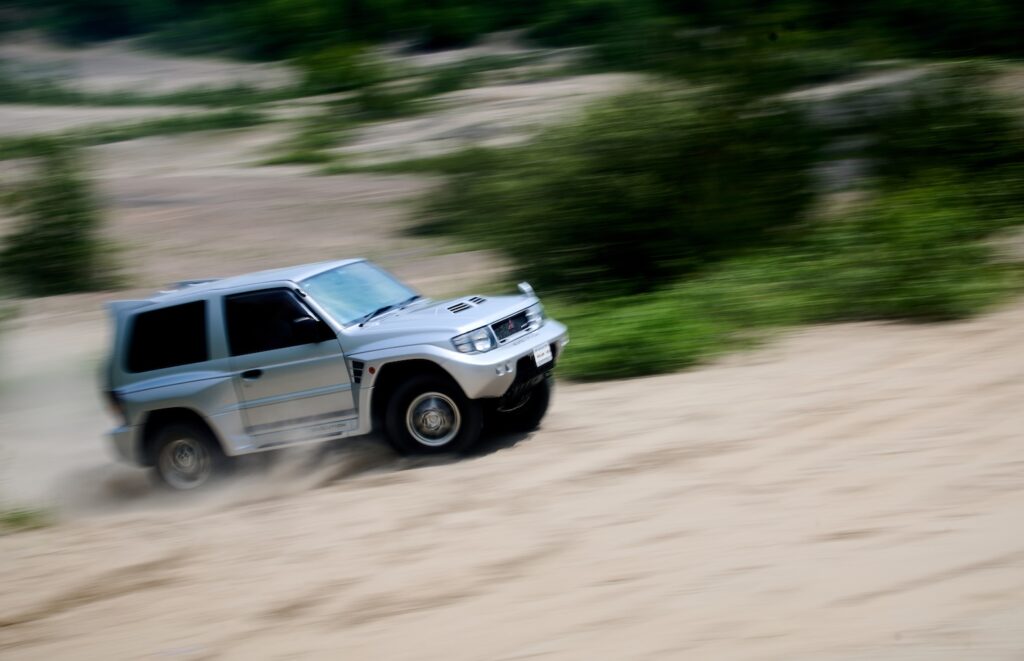
Even if the wheels land squarely and hold the car on a steady path, this shock could kill a powertrain and end a race. At risk of offending purists, then, another solution: an automatic transmission.
By capitalizing on the slushy torque-converter trait that enthusiasts are so quick to bemoan, five-speed automatic transmissions in the Dakar-winning Pajero Evolutions — and some 80 percent of street-homologation cars, this example included — successfully insulated the trucks from clutch-ripping, crank-twisting torque shocks. The converter could still of course lock itself for a more powerful and efficient straight-through connection, but easing off the pedal relaxed the connection to absorb the punishment.
Shifts aren’t quick, but this isn’t such a concern. With relatively little shifting required along so many thousands of kilometres’ open spans, the automatic is a reasonable compromise. Take over manual control and you quickly learn to time inputs for a moment before the power will actually be required. It’s neither a great hardship nor a particular disappointment, and while a small handful of units were built with manuals, it’s hard to see much of a case for the significant premium they carry on today’s market. Three pedals might be fun around town, but those who actually exercise their Pajevos should surely appreciate not having to feather and heat their clutch through difficult obstacles.
Not that slow-plod obstacles are really the idea here anyway, but of course the Pajero Evo runs equipped for them as well. The Evo can first be switched into four-wheel-drive, then lock its centre differential to match front and rear torque, and finally drop its two-speed transfer case to a low-range ratio of 1.9:1 for modest crawls out of predicaments. This isn’t a Utah crawler by any means, but together with Torsen limited-slip differentials, it’s enough to get the truck through plenty of tough verticals without needing help. Worst case: a thick recovery ring protrudes from the spot usually occupied by a trailer hitch, while another emerges from behind the thick underbody plating that protects the front.
More suited to its element is the way the Evo can brace for challenges without losing speed. Though primarily intended to be driven in rear-wheel drive for fuel-stop-dodging economy and tighter turns, four-wheel drive can be seamlessly engaged at up to 80 km/h. Spot some loose-looking sand or other tractive anxieties ahead, and thanks to the rare integration of a synchronizer inside its transfer case, the Pajevo can adapt on the fly where competitors would first be forced to stop. An unremarkable nudge of the left wrist, but perhaps an overtake’s difference on the rally stage.
That it’s all just so unexpectedly straightforward well at hand is a still-greater accomplishment. Whereas so many homologation specials are exotic monsters that few might dare commuting regularly, the Pajero Evolution offers a near facsimile to its accomplished enduro-racer siblings while maintaining a remarkable approachability.
Easy in town and equally ready for the trail without any greater inconvenience or discomfort, this performance icon stuck the landing as an unlikely but entirely credible daily driver, then a fast-paced plaything for the weekend on top.
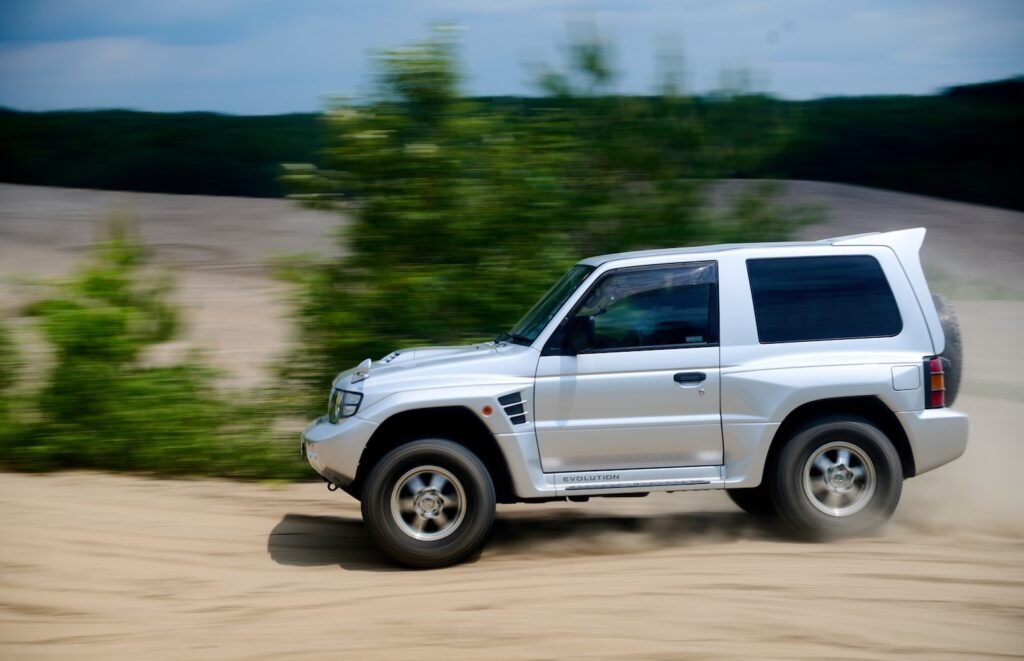
It’s hard to overstate how important this is to modern off-road enthusiast trucks. Desert winds may have swept sand across their popular memory, but trace those footsteps back from the bonkers-performance off-road utes of today and you’ll find that the Ford Bronco Raptor and Land Rover Defender Octa are configured rather as you see here.
By anchoring itself with wide-set fully independent suspension in particular, this 1990s pioneer brought a flavour of enthusiast motoring that dealer-goers hadn’t yet been exposed to. What’s more, the Pajevo gave footing to other companies’ engineers by demonstrating what comforts and feats a four-by could accomplish on coil springs and control arms.
More than just its novelty as a homologation special then, more than its proximity to the race trucks’ repeat class wins, more than its unexpected triumph over higher higher-class prototype competitors in its first Dakar race, the Mitsubishi Pajero Evolution redefined off-roading in its time — and for a generation to come.